
Technology in Education: Powerful Weapon or Greatest Foe?
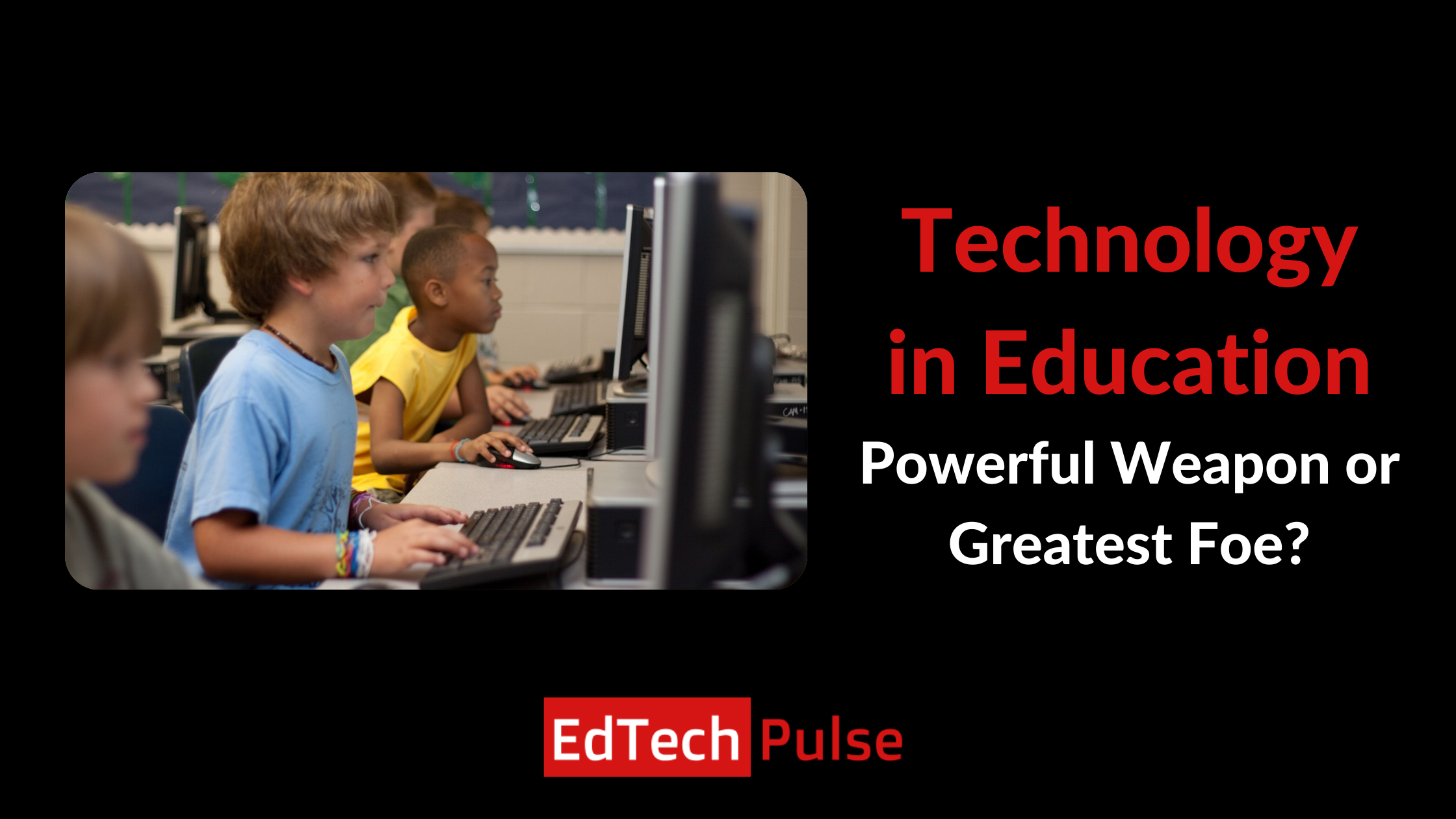
The students sit and listen as the teacher gives a lecture in the front of the classroom. Some students seem to be paying attention and have their books or chapter notes open in front of them. Many seem uninterested, while others converse with their neighbors.
With the advent of technology, the environment is not much altered, except that students use computers, tablets, or cellphones instead of books these days.
The scene might make some educators and parents sceptical about using technology in education. Is it utilized or misused? Is it more of a foe than a weapon?
While some view technology as a foe, another group views it as a mere medium to improve the way students are educated. They perceive technology as a means to share knowledge and information, communicate better, build communities and inculcate a culture of professionalism in students.
The COVID-19 pandemic clearly showed why online education ought to be an important component of teaching and learning. Teachers have begun utilizing online learning as a potent instructional tool by incorporating it into existing curricula rather than using it only as a crisis-management tool.
In fact, Dr. Heidi-Hayes Jacobs, an internationally recognized education leader, says, “Teachers need to integrate technology seamlessly into the curriculum instead of viewing it as an add-on, an afterthought, or an event.”
Let’s peek into the vitality that technology has imparted to education, making it a mighty weapon.
Technology in Education: A Closer Look at Its Imperative Role
Are any of us still wondering how important is technology in education? Undoubtedly, technology has played a great role in enhancing the quality of education.
Educational technology has improved communication and collaboration. Be it between teachers and students, students and parents, teachers and peers, or students and peers. Also, teachers can connect with students to clear any confusion via one-on-one engagement in the classroom online.
There are several e-learning tools available to teachers, thanks to educational technology. For instance, gamification, AR/VR, and smart boards. Furthermore, teachers can effectively instruct students by using video courses, microlearning, appealing infographics, etc.
More materials are available to students around-the-clock, allowing them to better tailor their education. We are well aware that not every student learns at the same rate. Thus, personalized learning enables people to tailor the amount of material they get to their specific needs.
Overall, technology plays a significant role in many facets of society, and its incorporation into the educational process has enormous learning potential for students.
Having Said That…
While many favor the advent of technology in education, some are against it or concerned about the misuse of technology.
The apprehension is more concerned with dehumanizing educational environments and possible adverse effects on health. Those who don’t favor ed-tech believe that it’s distorting social interactions between teachers and disturbing the relationship among them. Moreover, according to them, technology has isolated students in a digital and virtual world, distancing them from social interaction.
And the ones concerned with the health of students blame it on more screen time, impaired emotional and social intelligence, technology addiction and social isolation.
But, Is It So?
“Yes, kids love technology, but they also love legos, scented markers, handstands, books and mud puddles. It’s all about balance,” says Brian Aspinall, a leading educator and STEM innovator. Therefore, mentioning the pervasive impact of technology on the education sector shouldn't be limited to discussing its harms.
As far as social interactions are concerned, technology in education has redefined how students and teachers communicate and collaborate, rather than disturbing conventional social interactions. This might be as easy as taking an interactive quiz in class or participating in group discussions using technology. It might also incorporate more complex activities like attending a virtual field trip, doing science experiments in a virtual lab, or playing educational games.
Talking about the harmful effects of technology on health, these problems are because of using too much technology. Thus, if not used in a controlled manner, they can hurt students’ health.
Technology is more than just utilizing the newest tools and applications while being enthusiastic about doing so. Therefore, discussions about technology that do not include its actual motives in education would be flawed and lacking.
What’s in Store for the Future?
“Education is no longer an ‘event’ of school followed by college and the eternal quest to have a degree on your CV. How you learn, how often you update and upgrade yourself, and more importantly how you adopt soft skills to make you a rounded professional, are going to be key, says Ronnie Screwvala, co-founder, upGrad.
Thus, considering the future scenario, technology will fulfill this demand of staying updated. When it comes to keeping up with the quickly evolving learning system and peripherals, relying entirely on the offline education system can have many drawbacks.
Developing a hybrid education system in India, rather than solely depending on offline or online learning, is the ideal course of action. It will ensure a comprehensive and all-inclusive approach to student education.
The convergence of online and offline learning is thus the focus of ed-tech. We are currently in a hybrid learning era when attracting and keeping students depends equally on online and offline components. This way, technology will not only maintain its relevance and traction under changing circumstances but also stabilize a fair amount of usage, preventing exploitation and harmful effects.
Conclusion
It's crucial to remember that technology is a tool and not an end in itself, especially in education. What educators, parents, and students use technology for and how they use it to best support students' and educators' needs will determine whether technology in education lives up to its potential. Nothing can replace competent teachers and effective parent participation.


Comments
Be the first to comment.